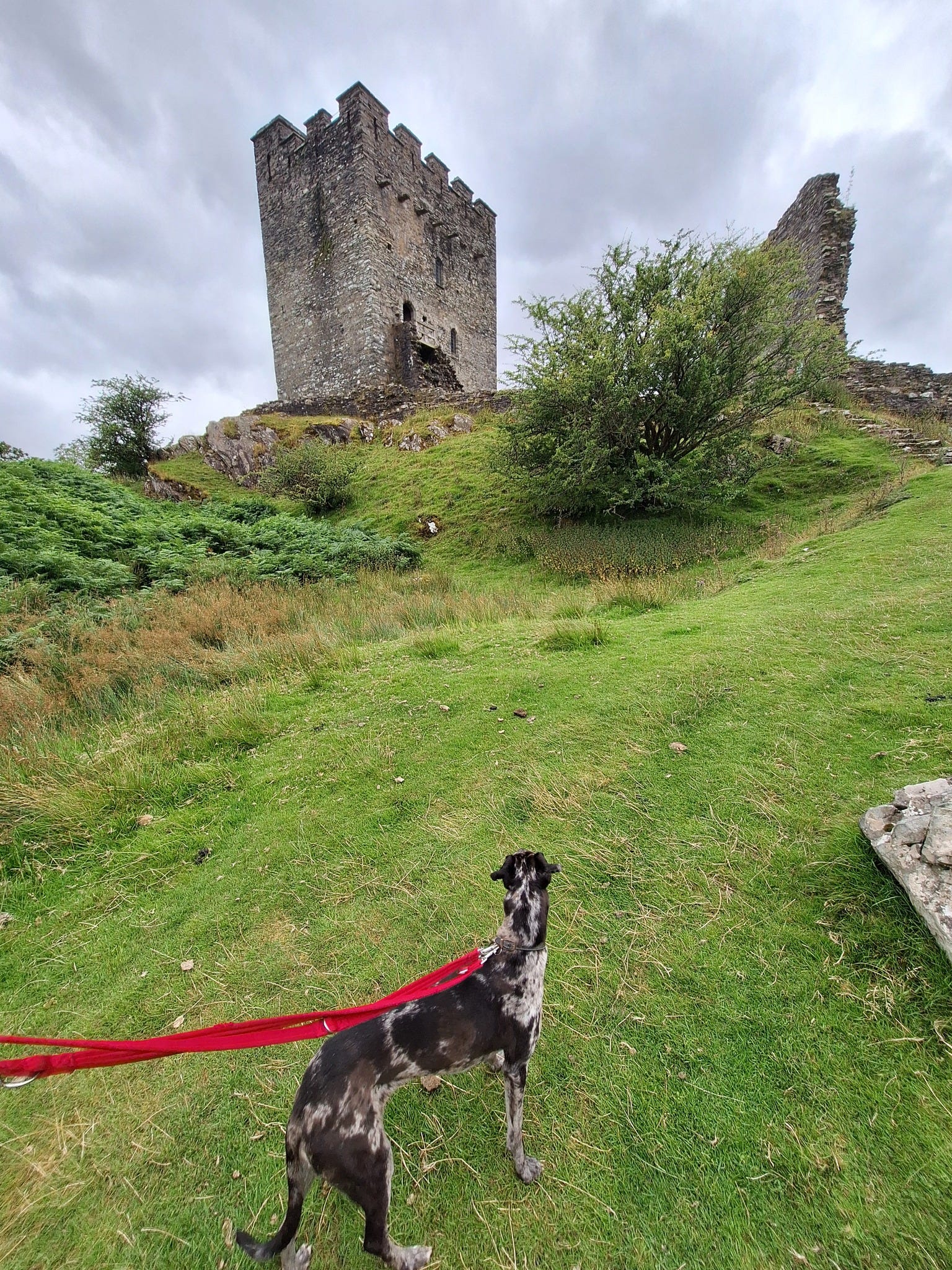
The Welsh Robin Hood

While discussing all these English outlaws, I should not ignore the Welsh variety.
One particular tale centred on the castle of Dolwyddelan in North Wales, now a romantic ruin. During the Wars of the Roses, it was the subject of a vicious feud between rival Welsh gentry.
At the start of the reign of Edward IV, the castle was occupied by one Hywel ap Ieuan, a grandson of Rhys Gethin, one of the chief supporters of Owain Glyndwr.
Hywel, a Yorkist, was opposed by Dafydd ap Siencyn. Dafydd was a poet and Lancastrian partisan, sometimes described as the Welsh Robin Hood. After a bitter struggle for control of the region, Dafydd seized Hywel and his concubine while they lay in bed together, and brought them as prisoners to Conwy Castle.
Dafydd then fell foul of the law, and had to flee to Ireland for a year. He returned in the summer and took to the forests with his followers, whom he dressed all in green. They lurked about the woods and highways, or took shelter with Dafydd’s friends, ‘walking in the night for fear of his adversaries’. It was said the locals thought they were fairies, and fled in terror of the outlaws.
At last, in 1468, Edward IV sent William Herbert, Earl of Pembroke, to root out Dafydd and the Lancastrians in North Wales. He marched into Nant Conwy, burning and killing, until the entire commote was ‘brought to utter desolation’. Dafydd himself was killed, although the circumstances are unclear: according to a verse or ‘englyn’ he composed on his deathbed, he had suffered three fatal wounds in a brawl.
Herbert’s destructive campaign left much of Nant Conwy waste. The castle and township were left abandoned, the woods swarming with thieves and outlaws. The commote had become a no-go zone, where no sensible man entered without an army at his back.
These were the conditions - in Wales or England or anywhere else - that bred outlaw legends.
Mai the History Dog is most intrigued.