
Battle? What battle?

On the subject of battles, it is striking how unevenly they are remembered. Some pass into legend, acquiring layers of meaning far beyond the event itself. Others—no less dramatic—fade almost entirely from view. The difference is rarely about scale alone. It is about what later generations find useful to remember.
One example is the battle fought at Beglés in Gascony on 27 April 1296. Here, the army of Edmund of Lancaster and Henry de Lacy defeated a French force drawn from the garrison of Bordeaux and the Bordelais militia.
Wage roll evidence suggests Edmund had around 185 English men-at-arms, supported by Welsh archers, a number of pressed English convicts, and several hundred Gascon gentry with their retinues. The size of the opposing force is unclear, but it represented a substantial local levy.
The battle itself was tactically sophisticated. The English executed a feigned retreat, drawing the French and citizen militia out from the safety of Bordeaux. Once their pursuers were sufficiently exposed, the English turned and counterattacked.
The result was a rout. One English chronicle claims that as many as two thousand French were killed; another records that thirty French nobles were slain and buried at the nearby place of the Friars Minor.
The aftermath contained all the elements of high drama. As the defeated forces fled, the levy of Bordeaux set fire to the suburbs to cover their retreat. Three English knights—Peter de Mauley, Alan la Zouche, and the unnamed standard-bearer of John of Brittany—pressed too far in pursuit and were trapped when the city gates were shut behind them. Surrounded, they fought back-to-back until they were killed.
By any narrative standard, this is compelling material: tactical deception, heavy casualties, and a heroic last stand. Yet Beglés is almost entirely forgotten.
The reason lies not in the event itself, but in what followed. Edmund and de Lacy lacked the means to exploit their victory. Without siege equipment, they could not take Bordeaux, and any expectation of a popular rising within the city proved illusory. The army moved on to Langon, and soon after Edmund died at Bayonne. His troops, unpaid and increasingly disaffected, began to drift away. The wider war in Gascony settled into a protracted and inconclusive struggle, eventually ending in truce.
In strictly military terms, Beglés was a clear tactical success but an operational dead end. It changed nothing of lasting significance.
This is the key to its disappearance from cultural memory. Battles are not remembered simply because they were fought, or even because they were won. They endure when they can be attached to a larger narrative—when they can be made to signify something beyond themselves.
Bannockburn becomes a story of national survival. Crécy becomes proof of tactical superiority. Hastings becomes the pivot of a new political order. In each case, the battle is a symbol, repeatedly invoked and reshaped to serve later needs.
Beglés offered no such utility. It did not decide a campaign, found a myth, or lend itself to easy interpretation. It was not incorporated into a broader story, and so it remained what it was: a local success in a confused and inconclusive war.
Even the sources hint at this limited afterlife. English accounts inflate the scale of the victory; alternative traditions reduce it to a more modest, if still costly, engagement. There is no strong competing narrative to sustain interest, no historiographical friction to keep the event alive.
In this sense, cultural memory is not a record of what happened, but of what later generations found meaningful. Beglés was not forgotten because it lacked drama, scale, or even heroism. It was forgotten because it never became useful.
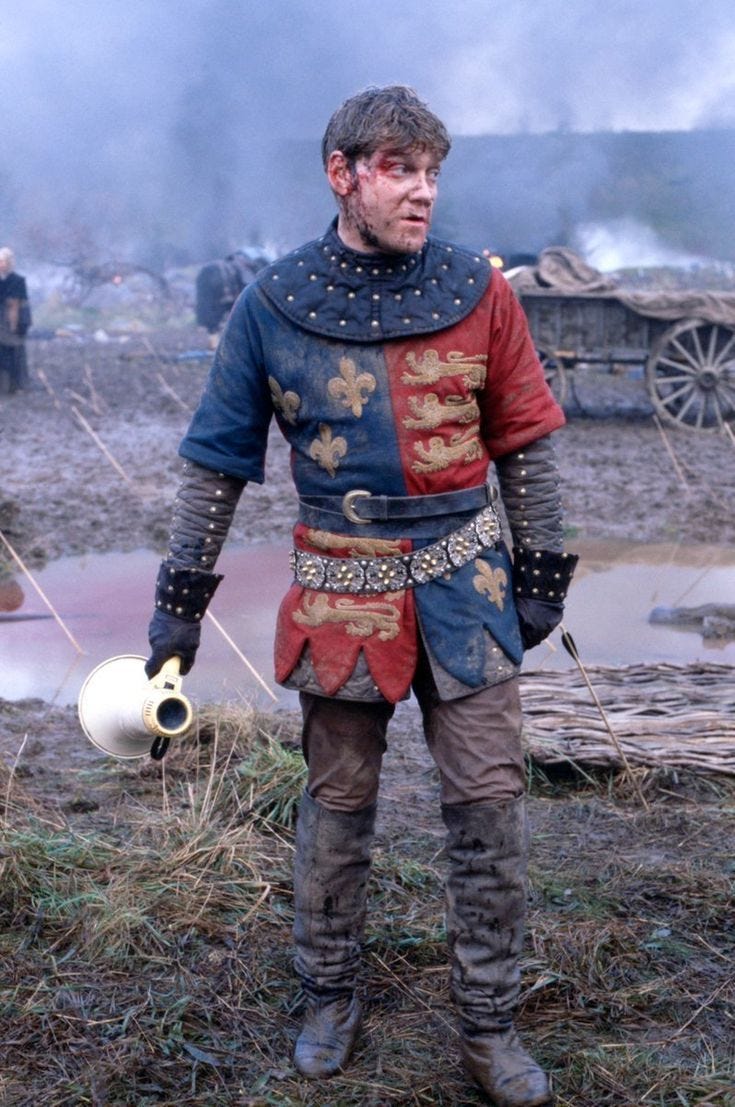
Oh, well. Attached is a pic of Henry V directing the Battle of Agincourt. Who knew megaphones were a thing in 1415?
That was really good. Always enjoy stories of the Hundred Years War.